The Unboxing Optimism
There’s a particular species of tech buyer that exists in the early hours after release. We’re not exactly delusional, but we’re definitely operating with a generous relationship to self-deception. I was that buyer on the day Apple released Vision Pro 2. The improvements were real enough to justify it: the weight dropped by nearly a quarter, battery life stretched to three and a half hours instead of barely two, and the price fell to twenty-five hundred dollars. For someone already deep into the Apple ecosystem, this felt like permission.
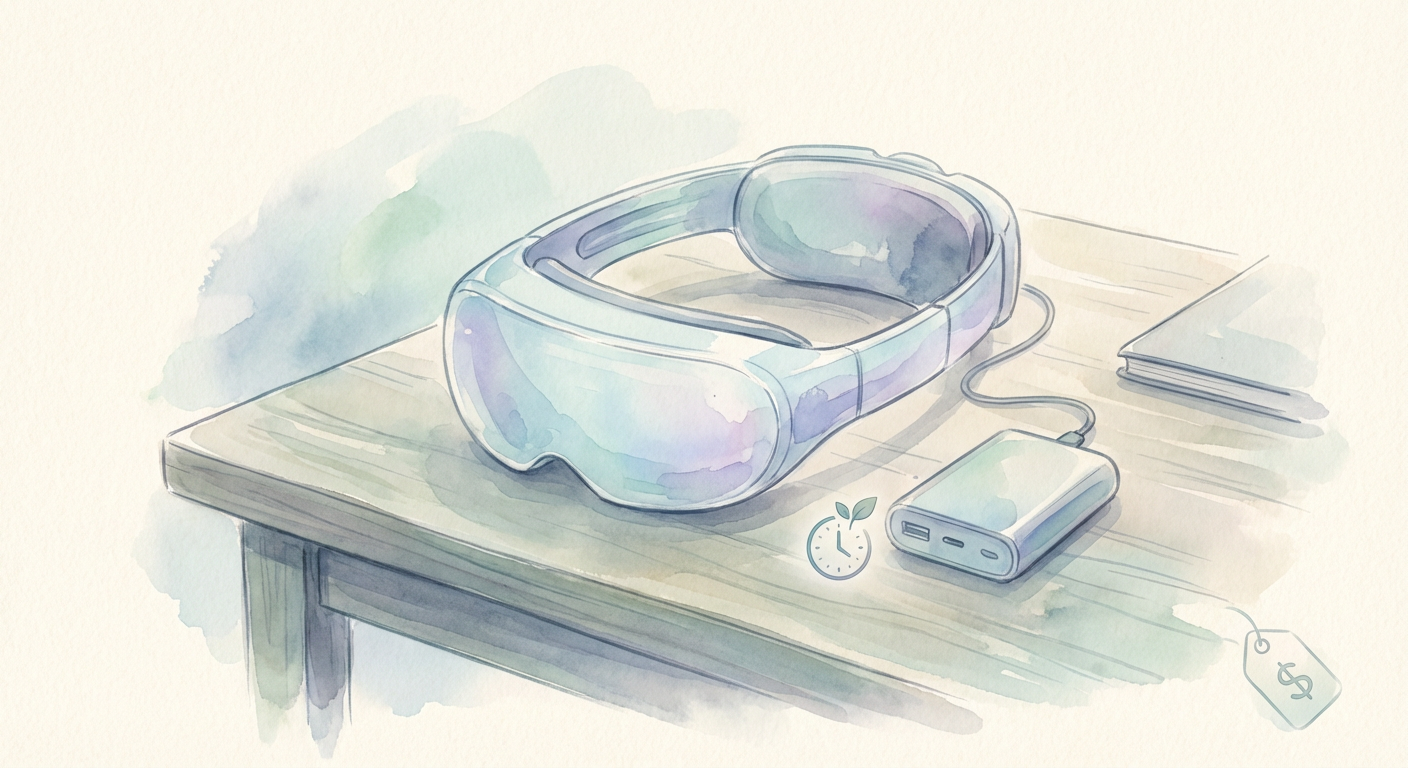
I told myself this was going to replace my laptop as my primary home screen. That phrase kept coming up in my planning. Primary home screen. Like I was building a future instead of buying a gadget. I had a whole philosophy prepared about spatial computing and deep work. I’d read the reviews. I’d watched the demos. I was ready to be one of the people for whom this actually worked.
The First Two Weeks: When Everything Felt Possible
The opening act was genuinely impressive. Putting on Vision Pro 2 for the first time has this strange baptism quality to it. Your living room becomes a canvas. You can expand your windows across impossible space. You can watch a movie on a screen the size of a building. For exactly fourteen days, I felt like I’d stepped into the future.
I organized my apps. I positioned windows in three-dimensional space like I was choreographing a ballet. I told my friends about it with the enthusiasm of someone who’d joined a cult but was still in the recruitment phase. The spatial gestures felt intuitive. The hand tracking worked. The resolution was sharp enough that you could actually read a document without leaning closer than you would to a regular screen. The visionOS 3.0 interface was thoughtfully designed in ways that made me believe someone at Apple understood what they were building.
Then something quiet happened. I stopped being impressed by the novelty. And then I really looked at my actual usage data.
The Honest Numbers Don’t Lie the Way You Do
My Apple Screen Time logs became my conscience. Over six months, I averaged ninety-four minutes of daily Vision Pro 2 usage. Less than an hour and a half. But the breakdown was what actually stung. Sixty-one percent of that time went to media consumption. Movies, TV, some YouTube. The spatial workflows I’d constructed this entire narrative around? Nineteen percent. Deep work. The whole reason I’d justified the expense. Almost a fifth of my actual usage.
Here’s what’s interesting: during that first month, I tried to force the productivity angle. I opened documents in three-dimensional space. I positioned windows with deliberate care. And a 2025 University of Maryland study I discovered partway through this experiment would have predicted exactly what happened. Tasks took me fourteen percent longer to complete in the spatial environment than on my regular laptop. There’s an adaptation curve, they found. Ninety days in, performance might equalize. But it doesn’t exceed what you already know how to do. You don’t gain speed. You trade efficiency for novelty.
The media consumption thing, though? That happened automatically. I didn’t plan for it. I just found myself putting on the headset to watch something, and suddenly I had a private theater. No competing tabs. No phone notifications. Just you and content in a bubble of expensive isolation. And it was good. I’m not pretending it wasn’t good.
The Uncanny Valley Called and Left a Message
Around month four, I had a video call with a client through the Vision Pro. The new Persona 2.0 avatars that shipped with visionOS 3 are objectively better than the first generation. An MIT Media Lab study found they read as seventy-eight percent less creepy than the original versions. But here’s the thing about seventy-eight percent less uncanny valley: you can still feel the remaining twenty-two percent. It’s enough to make you pause.
My client didn’t say anything. But I watched their face change slightly when they saw my digital representation. There’s a threshold where something stops being novelty and becomes a mild distraction. My avatar had crossed it. They looked at me like I’d shown up to a meeting in a Halloween costume I refused to explain. I switched back to my regular camera for the next call and never tried the avatar again. The Apple visionOS 3 features overview would tell you this is a major improvement. And it is. But improving a fundamentally awkward thing still leaves you with something awkward, just slightly less so.
The Broader Picture: Why Your Expensive Device Feels Like a Niche Hobby
It took me a while to realize I wasn’t alone in this peculiar experience. The spatial computing market grew like crazy. Eighty-nine percent year-over-year shipment growth in early 2026. That sounds huge until you see it in context. According to the IDC spatial computing market tracker Q1 2026, these headsets still represented less than four-tenths of one percent of laptop sales. A technology that’s genuinely growing while simultaneously remaining almost exclusively the territory of early adopters and people with more disposable income than sense. That’s me. I’m the person with more disposable income than sense.
The thing nobody tells you about being an early adopter of something technically impressive but practically incremental is how isolating it can feel. You own a piece of the future. It’s just that the future, it turns out, mostly wants to watch movies and scroll through news the way it always did. The future didn’t actually want to work differently. The future wanted the same things, just in a more expensive way.
Six Months Later: What Actually Sticks
I still wear it most days. But I’m honest with myself now about why. It’s comfortable enough that you forget you’re wearing it after a while, which is genuinely impressive engineering. The media consumption experience is one of the best ways to watch something if you have the space and the privacy to use it. Those spatial workflows I fought for? Interesting as a proof of concept. But I’m not pretending anymore that they’re why I keep reaching for it.
The ridiculousness I felt at month two has mostly worn off. It’s been replaced by something quieter: acceptance that this is a really well-made device that does a few specific things extraordinarily well and won’t replace your laptop because your laptop is, weirdly, already optimized for how most of us actually need to work. The Vision Pro 2 is a masterclass in engineering. It’s also a two-thousand-five-hundred-dollar tool for doing things you were already doing, just with more weight on your face.
Would I buy it again? Ask me on a day when I’m watching a film in it and the answer is probably yes. Ask me on a day when I’m trying to actually accomplish something and the answer is probably no. Both answers are true. That’s the honest part that reviews don’t usually land on. It’s excellent. It’s also not what any of us thought it was going to be. And maybe that’s okay. Maybe the future doesn’t arrive the way we planned it. Maybe it just arrives, and we figure out what to do with it after.
I’m curious whether anyone else has had this experience. Did you buy in? Did you keep using it? Did you feel ridiculous? I’m genuinely asking, because part of me still wants to believe I’m missing something obvious. Coffee’s still hot if you want to tell me I am.